12 Best Photo Spots Around Hollywood Walk of Fame
Sunset Boulevard traffic, costumed performers, flashing marquees, and tourists scanning the sidewalk for a favorite name - the best photo spots around Hollywood Walk of Fame are not hard to find, but the best angles usually are. This stretch of Hollywood is busy, visually layered, and often more photogenic from half a block away than directly on top of the star you came to see.
If you want memorable photos rather than crowded snapshots, a little planning changes everything. Hollywood rewards timing, positioning, and patience. It also helps to think beyond the stars themselves. Some of the strongest images in the area come from historic theaters, elevated viewpoints, and side-street compositions that frame old Hollywood and present-day Los Angeles in the same shot.
Best photo spots around Hollywood Walk of Fame
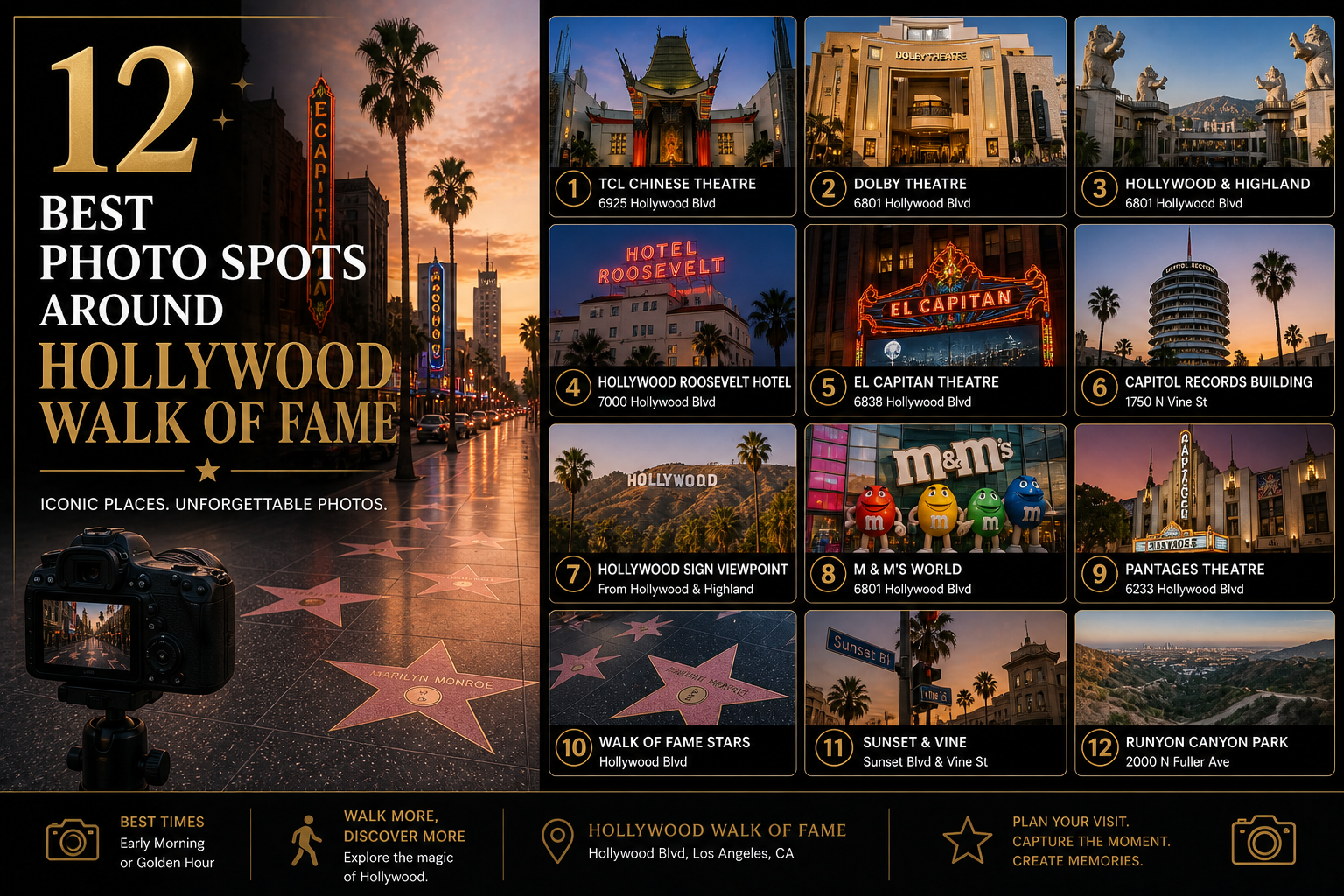
The most obvious place to start is right on Hollywood Boulevard, but not every section photographs equally well. The blocks around TCL Chinese Theatre and the Dolby Theatre offer the densest concentration of recognizable Hollywood visuals. You get the stars underfoot, palm-lined street perspectives, theater facades, and a constant sense of motion. If you want a classic Walk of Fame image, this is where the area feels most cinematic.
TCL Chinese Theatre remains one of the strongest photo stops because it gives you more than one subject. The ornate exterior is dramatic in daylight and even better as the light softens in late afternoon. The forecourt with celebrity handprints and footprints adds texture and scale, and if you step back slightly, you can capture both the architecture and the crowd energy that makes the location feel unmistakably Hollywood. The trade-off is popularity. Midday can feel packed, so an early morning arrival gives you cleaner compositions.
Just steps away, the Dolby Theatre entrance offers one of the most polished visual frames in the district. The grand stairway and arching columns create a more refined look than the sidewalk alone, and from the upper levels you can often catch a clear view toward the Hollywood sign. That combination matters if you want photos that feel elevated rather than purely tourist-driven. It is also one of the better options for couples, families, and small groups who want a portrait setting with a little structure behind them.
For travelers who want a strong sense of place, the Hollywood & Highland area is especially useful. It gives you layered shots with street life below and landmark architecture around you. The shopping complex itself is not the star, but its vantage points are. Look for sightlines that pull the eye toward the hills. On a clear day, that extra depth makes an ordinary Hollywood photo feel much more intentional.
The landmarks that photograph best nearby
The Hollywood Roosevelt is one of the most stylish stops near the Walk of Fame, especially for visitors who prefer classic Los Angeles over novelty. Even the exterior has presence. Its Spanish Colonial Revival design, tall palms, and long association with film history give photos a quieter kind of glamour. This is not the loudest image in Hollywood, which is exactly why it works. If you are aiming for elegant travel photos rather than playful street scenes, this is one of the best nearby settings.
Across the street, the El Capitan Theatre and the neighboring historic facades can add color and vintage character to a walking photo set. The marquee lighting, vertical signage, and restored details feel distinctly cinematic. These spots work particularly well in the early evening, when the boulevard starts to glow but the sky still holds some color. If your goal is atmosphere, this hour is often better than harsh noon light.
Capitol Records is a short drive from the central Walk of Fame blocks and worth the small detour. Its circular, stack-of-records design is instantly recognizable, and the building photographs best with a little breathing room around it. Street-level shots can work, but wider compositions from across the road usually feel stronger. This is a smart stop if you want to broaden your gallery beyond stars and theater entrances while still keeping the Hollywood identity intact.
The Hollywood sign itself is not on the Walk of Fame, but several nearby positions let you include it in your route. One of the easiest is from the Hollywood & Highland complex, where the sign appears framed by the surrounding hills. It is not a wilderness-style sign photo, and that is part of the appeal. You get the contrast of urban Hollywood in the foreground and the iconic hillside beyond.
Where to get better angles, not just famous ones
If you have ever looked at a Hollywood photo later and thought it felt flatter than the moment itself, angle was probably the issue. Sidewalk-level shots aimed straight down at a star are fine for documentation, but they rarely feel special. A better approach is to use people, storefront reflections, or theater architecture to create context. The Walk of Fame is less about isolated subjects and more about layering.
One underrated strategy is to move onto side streets just off Hollywood Boulevard. From there, you can often frame the main boulevard with less congestion in the foreground. You may also get cleaner views of signs and facades without a constant line of pedestrians crossing the shot. It depends on the hour, but even a one-block adjustment can improve the image dramatically.
Parking and traffic also shape your experience more than most visitors expect. Hollywood can turn a short route into a frustrating one, especially if you are trying to fit photos into a dinner reservation, event schedule, or airport arrival day. That is one reason many travelers prefer a professionally coordinated transfer or chauffeured outing when visiting high-traffic districts like this. It keeps the focus on the experience rather than the logistics, which matters even more for families, wedding guests, and international travelers adjusting to Los Angeles pace.
Best times to photograph the Walk of Fame
The best light around Hollywood Walk of Fame usually comes in the first two hours after sunrise and the last ninety minutes before sunset. Early morning gives you the cleanest sidewalks, softer contrast, and a better chance of capturing landmark exteriors without heavy foot traffic. If you want a polished set of photos with fewer distractions, morning is the strongest choice.
Late afternoon into blue hour is ideal if you want Hollywood to feel lively and cinematic. Theater lights begin to show, signage becomes richer, and the boulevard looks more dramatic. The compromise is crowd density. Your photos may have more atmosphere, but they will probably include more people. For some travelers that is a negative. For others, it is the whole point.
Midday is the hardest time to work with because sunlight can be sharp and shadows can cut across faces and sidewalks. If midday is your only option, prioritize shaded facades, tighter compositions, and indoor-outdoor transitions such as theater entrances. You can still get strong images, but you have to be more selective.
Photo tips for couples, families, and VIP itineraries
Different travel styles call for different stops. Couples often do best with a mix of iconic and elegant settings - one classic star shot, one theater backdrop, and one polished architectural location like the Roosevelt or Dolby Theatre. Families usually prefer areas where the photo stop is quick, recognizable, and easy to access without too much walking between landmarks.
For groups, coordination matters more than people think. Hollywood sidewalks are active, and large parties can get separated quickly. A timed arrival with a chauffeur waiting nearby keeps the outing efficient, especially if the Walk of Fame is only one stop on a fuller Los Angeles day. For guests balancing studio tours, dinner reservations, or red-carpet events, that level of planning can turn a crowded district into a very smooth experience.
If your visit includes luggage, formalwear, children, or older family members, comfort should factor into the route. The most photogenic plan is not always the most practical one. Often, the best experience comes from selecting four or five strong stops instead of trying to cover everything on foot.
Hollywood rarely looks exactly like it does in the movies, but that is part of its charm. The area is more textured, more crowded, and often more interesting in person. If you choose your timing well and let the neighborhood’s history and energy work for you, the photos will feel less like proof you were there and more like a record of a very Los Angeles moment.