Dodgers Stadium Guide: Avoid Traffic Headaches
You can leave a five-star hotel on time, book great seats, and still spend the first inning staring at brake lights on Vin Scully Avenue. That is why this dodgers stadium guide: avoid traffic & parking headaches matters so much. At Dodger Stadium, the game-day experience often depends less on your ticket and more on how intelligently you arrive.
For visitors, corporate hosts, and families managing a full Los Angeles itinerary, this is not a small detail. Stadium traffic can feel unpredictable if you are unfamiliar with the area, and parking logistics are rarely as simple as they look on a map. The good news is that with the right timing, entrance strategy, and transportation plan, the trip can be far calmer than many people expect.
Dodgers Stadium guide: avoid traffic & parking headaches before you leave
The biggest mistake guests make is treating Dodger Stadium like a downtown arena with quick in-and-out access. It sits on its own hilltop, and that layout creates a bottleneck effect before major games, rivalry nights, giveaways, and weekend matchups. If you arrive late, the last mile can take far longer than the rest of the drive.
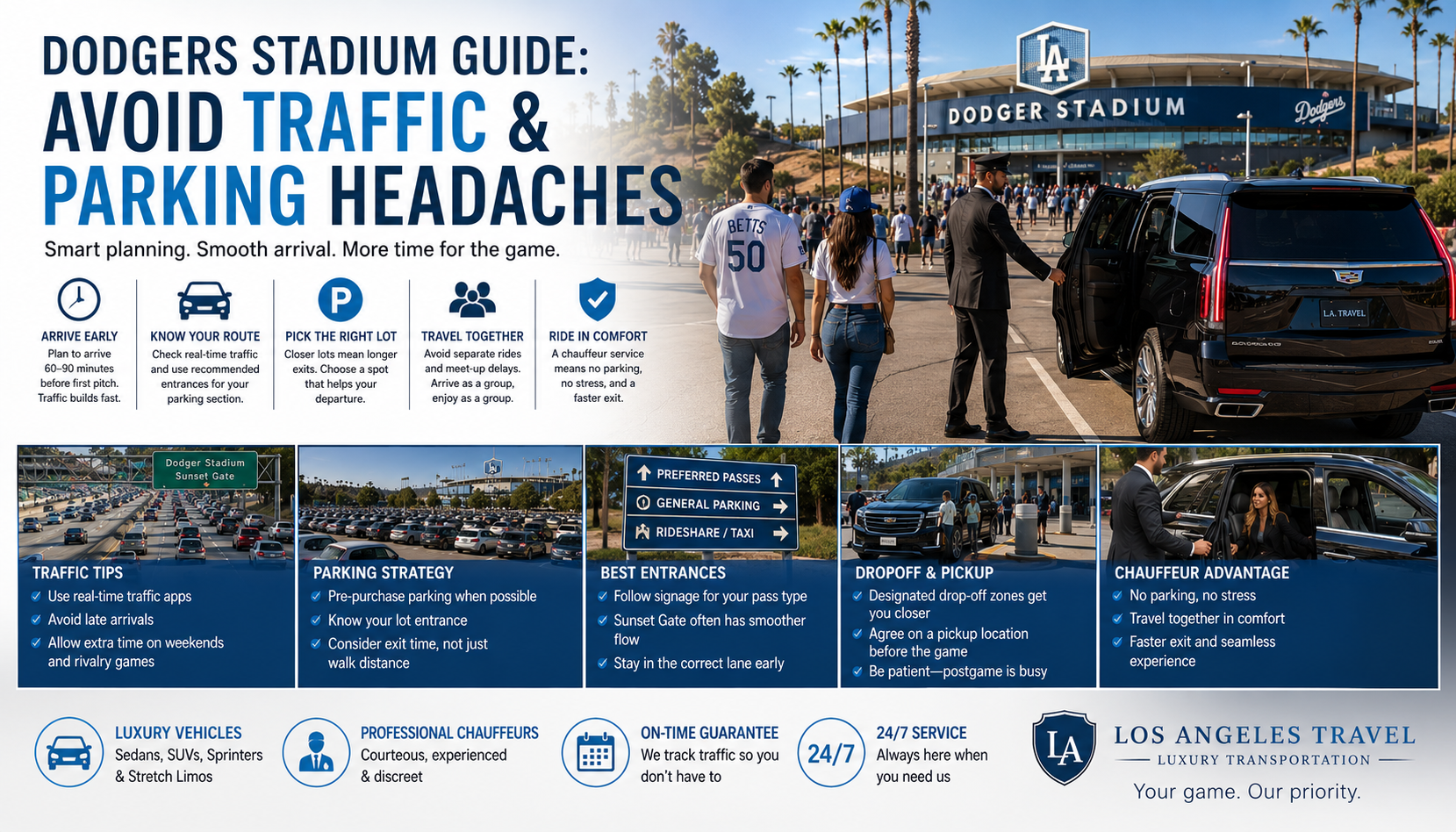
A practical target is arriving in the area 60 to 90 minutes before first pitch. For high-demand games, even earlier is sensible. This does not mean you need to sit in your car for an hour. It means you give yourself margin for security lines, lane backups, and the simple reality that thousands of people are trying to enter the same complex at once.
There is a trade-off here. Arrive too early and you may spend extra time waiting. Arrive too close to game time and your stress level rises immediately. For most guests, especially those traveling with children, older family members, or business clients, the earlier window is worth it.
Why Dodger Stadium traffic feels worse than expected
Los Angeles traffic is already famous, but stadium traffic has its own rhythm. Nearby freeways can be moving reasonably well right until the final approach, then suddenly slow as vehicles funnel toward specific gates. A navigation app may get you close, but it does not always account for how long it takes to enter, climb, park, and walk.
Another factor is that not every arrival pattern is equal. Drivers who commit too late to a gate or lane often get trapped in slower streams of cars. Visitors who are unfamiliar with the stadium sometimes follow the most obvious route rather than the most efficient one for their section, parking pass, or drop-off plan.
Then there is the departure issue. Many guests focus on getting in and forget that leaving can be the longer test of patience. If your evening includes dinner reservations, a flight connection, or a chauffeur waiting to continue your itinerary, the post-game plan deserves just as much attention as the arrival.
Picking the right arrival strategy
There is no single best way to reach Dodger Stadium. The right choice depends on your priorities.
If you want full control and do not mind walking a bit, driving yourself can work well when you arrive early. The upside is convenience for personal belongings, children, and flexible departure timing. The downside is obvious - you become part of the traffic problem, and after the game you may sit in a queue before you even reach the street.
Rideshare can remove the parking question, but it is not always the easiest option after the final out. Surge pricing, pickup confusion, and crowded designated zones can turn a simple ride request into a long wait. It is often more attractive on the way in than on the way out.
A pre-arranged black car or chauffeured SUV is typically the most composed option for guests who value timing, privacy, and a smoother curbside experience. You are not searching for parking, and you are not hoping a driver accepts your ride after a busy game. For international travelers, executive guests, or families coordinating from LAX or a hotel, that level of planning removes a surprising amount of friction.
Parking at Dodger Stadium without the usual regret
Parking is not inherently difficult at Dodger Stadium, but casual planning often leads to casual mistakes. The first rule is simple: know your parking arrangement before the day of the game. Do not assume you will sort it out while approaching the stadium.
The second rule is to think about the exit before you think about the walk in. Many guests instinctively chase the closest possible spot to their entrance. That can save a few minutes on arrival, but it may cost much more time after the game when entire rows are trying to leave at once. A slightly less convenient parking position can be smarter if it gives you a cleaner route out.
It also helps to remember what kind of evening you want. If you plan to stay through the final pitch and enjoy the full atmosphere, you may be comfortable waiting out the parking lot afterward. If you need to leave quickly for another commitment, your parking location matters much more.
Best mindset for self-parking
Think in terms of patience and position, not perfection. There may not be a magical space that delivers a short walk, a fast exit, and zero waiting. Usually, you choose which advantage matters most.
For families, a slightly longer wait in exchange for a simpler walk can be reasonable. For business travelers or anyone on a tight schedule, the faster exit may be the better call. That is where local driver experience can make a real difference.
A smarter drop-off and pickup approach
For many guests, avoiding parking entirely is the easiest win. A professional drop-off lets you arrive closer to the action without dealing with lot navigation, and it can be especially useful for guests in formalwear, elderly passengers, or groups who prefer not to split across multiple cars.
The key is coordination. A pickup after the game should never rely on vague texts like “I’m near the crowd.” Choose a clear meeting point in advance and expect some walking if needed. At a venue this busy, the fastest pickup is not always directly at the most crowded curb.
This is one of the clearest differences between rideshare and premium car service. With a pre-booked chauffeur, the logistics are established ahead of time. For guests balancing game tickets with airport transfers, private tours, or a broader LA schedule, that predictability is valuable.
Dodgers Stadium guide: avoid traffic & parking headaches on game night
Timing changes depending on the opponent, day of the week, and whether there is a promotion. A weeknight game against a less prominent opponent is different from a Friday rivalry game or a playoff atmosphere. If your tickets are for a marquee matchup, assume every part of the process takes longer.
If you are entertaining clients, attending with wedding guests, or organizing transportation for a small group, build your plan around comfort rather than minimum travel time. The extra buffer is not wasted. It protects the tone of the evening.
For guests staying in Beverly Hills, Downtown LA, Santa Monica, or arriving directly from LAX, the route also affects the feel of the trip. A private chauffeur can adjust in real time, but even then, no one can erase the laws of volume when thousands of fans converge at once. Good planning reduces pressure. It does not create miracles.
If you are visiting Los Angeles for the first time
Dodger Stadium can surprise international visitors because the stadium experience starts well before the gate. Distances look manageable on a map, but Los Angeles measures time differently, especially around major events. If you have arrived on a long-haul flight, are traveling with children, or are coordinating a group from a hotel, this is not the night to improvise.
It is also worth dressing for movement. Even premium seating does not change the fact that you may walk ramps, stairs, or parking lanes. Comfortable shoes and a simple arrival plan are often more useful than trying to engineer the perfect shortcut.
For travelers who want the evening to feel polished from start to finish, a reserved car service is often the quiet luxury move. Companies such as LosAngeles Travel are built for exactly this kind of guest - people who prefer discreet, reliable transportation over game-day guesswork.
When paying more makes sense
Not every guest needs premium transportation to Dodger Stadium. If you know LA well, are attending casually, and are comfortable managing the parking lots yourself, self-driving may be perfectly fine.
But if the evening includes VIP guests, family from overseas, a special celebration, or a packed schedule around the game, paying more can be the practical choice rather than the indulgent one. You are not only buying a vehicle. You are buying less uncertainty, better timing, and a calmer start and finish to the night.
That matters most when the game is just one part of a larger occasion. A baseball outing should feel like the event, not the obstacle course before and after it.
The best Dodger Stadium arrival plan is the one that protects your time, your mood, and the people you are with. If you treat transportation as part of the experience instead of an afterthought, the evening usually starts exactly where it should - with excitement, not frustration.